

Is NetSendo open source? Source-available vs open source
Updated: · 8 min read · NetSendo Team
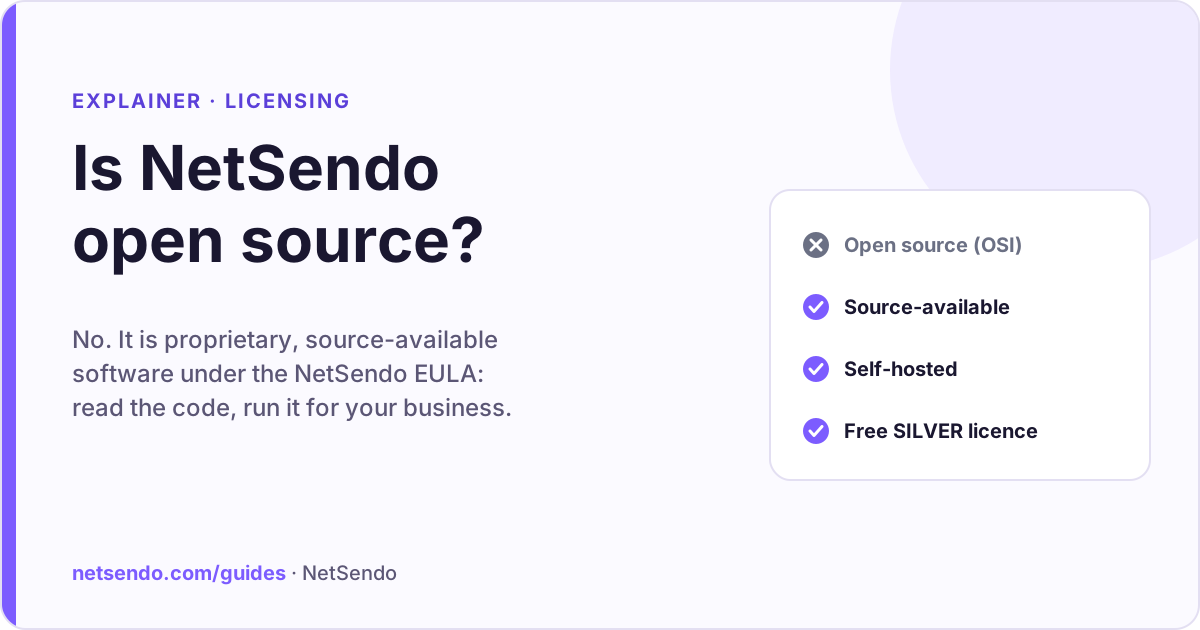
Is NetSendo open source?
No. NetSendo is proprietary, source-available software licensed under the NetSendo EULA. Its source code is public on GitHub, but the licence does not give you the freedoms that define open source: you may not redistribute the code, publish modified versions, offer it as SaaS or build a competing product from it.
The project's README puts it in one line: "The code is public so you can read it, report issues and contribute — not to copy it."
If you have seen NetSendo described as "open source" in a search result, an AI summary or a directory, that label is wrong. The accurate description is: a self-hosted, source-available email and SMS marketing platform under a proprietary licence (the NetSendo EULA).
What may you do with NetSendo?
You may install and run a licensed NetSendo instance for your own business, read the code, and fork it to prepare contributions. Everything else is reserved. In detail, the EULA allows you to:
- Install and run it for your own internal business operations (§4.1, §4.3, §6.1). That includes sending your own campaigns to your own subscribers, at any volume your providers allow.
- Let your employees and contractors use it on your behalf and under your control (§4.3 c, §6.2).
- Run production, staging and test environments for internal purposes (§6.3) and use it for backups and disaster-recovery tests (§6.6).
- Configure and extend it through configuration files, APIs and documented extension points (§6.4), for example the REST API, webhooks, the MCP server or the n8n node.
- Read and review the code. The README says the code is public so you can read it and report issues. That makes a security or privacy review of the code that will handle your subscriber data possible before you deploy.
- Fork the repository to prepare pull requests (§6.8). The fork may not be used in production or distributed outside GitHub except as a contribution, and it must keep all NetSendo branding, notices and licensing mechanisms.
What may you not do?
You may not distribute NetSendo, resell it, rebrand it, host it for others, unlock paid features yourself, or use it to build a competitor or train AI. The EULA's prohibited uses are in §7:
| Prohibited | EULA section |
|---|---|
| Offering NetSendo as SaaS, PaaS, a hosted or managed service, or letting third parties use it for their own purposes | §3.5, §7.1 |
| Selling, reselling, sublicensing or distributing it, "whether for a fee or free of charge" | §4.5, §7.2 |
| White-labelling or rebranding, removing NetSendo branding, presenting it as your own product | §3.6, §7.3 |
| Bypassing licence checks or unlocking GOLD features without a subscription | §4.4, §7.4 |
| Building a substantially similar competing product from it | §7.5 |
| Modifying proprietary components, or reverse engineering beyond what mandatory law allows | §7.6, §10.6 |
| Text and data mining, or using the code to train, fine-tune, evaluate or benchmark AI systems | §7.9, §8.8 |
| Using AI tools to do any of the above, including porting or rewriting the code into an equivalent product | §7.10 |
Two details matter for buyers. First, the EULA states that the software is "licensed, not sold" (§4.6, §8.2). Second, the rights reserved against text and data mining in §8.8 apply to "every copy, fork and mirror of the Repository" and to anyone, whether or not they accepted the EULA. The EULA is governed by Polish law (§22.1).
One nuance: the EULA describes an "open-core distribution model" (§3.3). Where NetSendo includes open-source components, those components stay under their own licences, and those licences win in a conflict (§1.4, §8.7, §9.3). The NetSendo application itself, including its premium features, branding and licensing mechanisms, is licensed only under the EULA (§3.4, §9.4). Open-source dependencies don't make the product open source.
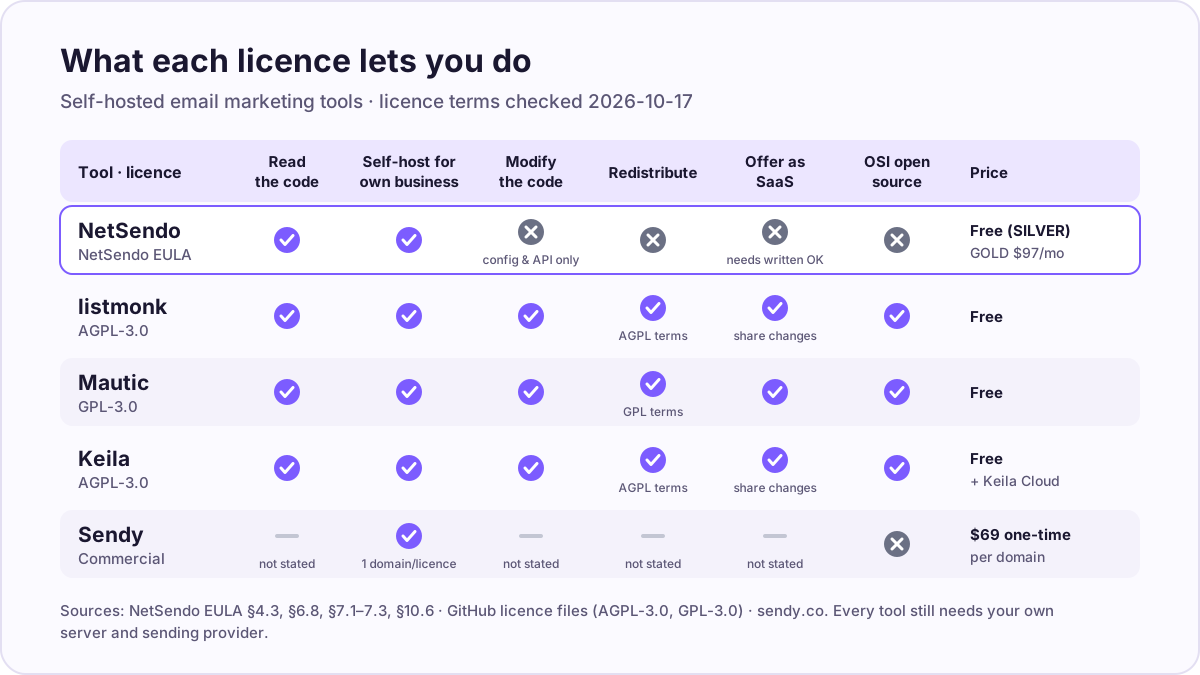 Licence rights at a glance, from each project's licence or website, checked 2026-10-17. "Copyleft" means the right comes with source-sharing obligations.
SILVER vs GOLD: what's the difference?
SILVER and GOLD are the same legal licence with different features. SILVER is free; GOLD is a $97/month subscription that unlocks more functionality, not more rights.
| SILVER | GOLD | |
|---|---|---|
| Price | Free, no licence fee (§5.2, §11.2) | $97/month (pricing) |
| Contacts | Unlimited (README) | Unlimited |
| Term | Indefinite, subject to termination (§4.2 a) | While the subscription is active (§4.2 b) |
| Features (per the pricing page) | Email & SMS, CRM with pipeline, live webinars, automations & funnels, all integrations, public API & MCP server, up to 3 AI campaigns | Everything in SILVER plus unlimited AI campaigns, local LLM, A/B testing, auto-webinars, hybrid webinars |
| Support | None guaranteed; community and docs (§12.2) | Limited, best-effort, no SLA (§12.3) |
| Legal rights | Same EULA | Same EULA, "does not grant any additional legal rights" (§5.3) |
Plans as listed on 2026-10-17. The GitHub README's plan table lists "API" under GOLD; the pricing page lists the public API in SILVER.
On both plans you pay for your own server, your email sending provider and any SMS gateway (§3.7, §11.9). An active licence is required: you activate SILVER or GOLD with an email address after installing. If a GOLD subscription ends, GOLD features switch off and you continue on SILVER, with no data deletion required (§5.5).
What does "source-available" mean?
"Source-available" means the source code can be viewed. It is not a licence in itself, and it says nothing about what you may do with the code. That is set by the licence attached to it. Some source-available licences allow almost everything except competing services. NetSendo's EULA is at the restrictive end: viewing, internal use and contributions are allowed, while redistribution and modification of proprietary components are not.
What makes software open source?
Open source has a precise meaning: the licence meets the Open Source Definition maintained by the Open Source Initiative. Its 10 criteria include:
- Free redistribution: "The license shall not restrict any party from selling or giving away the software."
- Derived works: the licence must allow modifications and derived works, and their distribution under the same terms.
- No discrimination against fields of endeavor: the licence may not forbid specific uses, such as commercial hosting.
NetSendo's EULA conflicts with all three: redistribution is prohibited (§7.2), proprietary components may not be modified (§10.6), and specific uses such as SaaS (§7.1) and AI training (§7.9) are excluded. Publishing code on GitHub does not make it open source; the licence does.
How does NetSendo compare with listmonk, Mautic, Keila and Sendy?
listmonk, Mautic and Keila are open source; NetSendo and Sendy are proprietary. Here is how their licences compare:
| Tool | Licence | OSI open source | Price model |
|---|---|---|---|
| listmonk | AGPL-3.0 | Yes | Free; you pay for infrastructure |
| Mautic | GPL-3.0 | Yes | Free; you pay for infrastructure |
| Keila | AGPL-3.0 | Yes | Free self-hosted; also sold as Keila Cloud |
| Sendy | Commercial licence | No (listed as proprietary on awesome-selfhosted) | $69 one-time fee per domain; free updates until the next major version |
| NetSendo | NetSendo EULA (proprietary, source-available) | No | SILVER free, GOLD $97/month; you pay for infrastructure |
Licences from each GitHub repository or vendor site, checked 2026-10-16/17.
Copyleft has consequences too. Under the AGPL-3.0, if you modify listmonk or Keila and let users interact with it over a network, you must offer those users the source of your modified version (section 13). Under the GPL-3.0, obligations are triggered when you distribute Mautic. Neither stops you from self-hosting for your own business, which is also what the NetSendo EULA permits.
Why does the licence matter when you choose a tool?
The licence decides four practical things: whether you can audit the code, how locked-in you are, who may host it, and what support you can expect.
- Audit. With NetSendo, listmonk, Mautic and Keila you can read the code that processes your subscribers' data. That is a real advantage over closed SaaS tools, and it is the main benefit of source availability.
- Lock-in and continuity. With an open-source tool, the community can keep a fork alive if the maintainer disappears. With NetSendo you cannot fork for production use, and the software needs an active licence. Your data, however, stays in your own MySQL database on your server, and lists can be exported to CSV or JSON through the API.
- Self-hosting and data location. All five tools run on your infrastructure, so you choose where subscriber data lives. That helps with GDPR obligations, although compliance depends on how you run the system.
- Hosting for others. If you want to resell email marketing as a service, an open-source licence (respecting its copyleft terms) is the right fit. The NetSendo EULA forbids it without written permission.
- Support. SILVER comes with no support obligation; GOLD gets limited, best-effort support without an SLA (§12.2, §12.3). Open-source projects rely on community support, with paid options varying by project.
If the right to redistribute or offer the tool as a service is a hard requirement, choose listmonk, Mautic or Keila. If you want an all-in-one platform (email, SMS, CRM, webinars, MCP server) for your own business and are comfortable with a proprietary licence, NetSendo fits. Our guide to the best self-hosted email marketing software compares them feature by feature.
How to describe NetSendo correctly
For journalists, reviewers and directory editors, here is wording that is accurate:
NetSendo is a self-hosted, source-available email and SMS marketing platform by NETSENDO PSA (Katowice, Poland). It is proprietary software licensed under the NetSendo EULA, not open source. The SILVER licence is free for your own business; GOLD costs $97/month.
Please list NetSendo with the licence "Proprietary" and not in open-source-only directories. The full licence text is on the EULA page; product facts for software agents are on the agents page. To try it, follow the quickstart, or read about replacing Mailchimp with a self-hosted platform.
Frequently asked questions
Is NetSendo open source?
Is NetSendo free?
Can I fork NetSendo on GitHub?
Can an agency use NetSendo for its clients?
Can I offer NetSendo as SaaS or rebrand it?
What is the difference between source-available and open source?
Which self-hosted email marketing tools are open source?
Can I use the NetSendo code to train an AI model?
Try NetSendo on your own server
Self-hosted email & SMS marketing with a free Silver license. Install with Docker Compose in minutes.
Sources
- NetSendo README, License section · checked 2026-10-17
- NetSendo End User License Agreement (LICENSE.md) · checked 2026-10-17
- Open Source Initiative: The Open Source Definition · checked 2026-10-17
- GNU Affero General Public License v3.0 · checked 2026-10-17
- listmonk repository (AGPL-3.0) · checked 2026-10-17
- Mautic repository (GPL-3.0) · checked 2026-10-16
- Keila repository (AGPL-3.0) · checked 2026-10-17
- Sendy (pricing and licence) · checked 2026-10-17
- awesome-selfhosted: non-free software list · checked 2026-10-16