

Best self-hosted email marketing software in 2026
Updated: · 13 min read · NetSendo Team
Which self-hosted email marketing software should you pick?
The right tool depends on what you send and who runs the server. Our short answer, after checking each project's own site and repository on 16–17 October 2026:
- Lean newsletter, open source: listmonk. It is fast, mature and has the largest GitHub following in this group. Keila is a friendlier, smaller option.
- Open-source marketing automation: Mautic. It has a campaign builder, lead scoring and landing pages, and it is the established choice when the licence must be OSI open source.
- Cheap commercial broadcast tool on Amazon SES: Sendy, for a one-time $69 per domain. MailWizz if you want to resell sending to clients.
- Email + SMS + CRM + webinars + AI in one app: NetSendo. It is source-available (not open source), with a free SILVER licence for your own business. You still pay for the server and for sending.
If nobody on your team can look after a Linux server, DNS records and backups, stay on SaaS. That is a legitimate answer, and it is the first box in the decision flow further down.
What does "self-hosted email marketing" actually mean?
Self-hosted means the marketing application (lists, sign-up forms, templates, campaigns, automations, reports) runs on a server you control, and the subscriber database lives there too. You install it, update it and back it up.
It usually does not mean you deliver every email from your own mail server. Most self-hosted setups hand the actual delivery to a relay:
- Amazon SES, Mailgun, SendGrid or another SMTP/API provider. You pay per email and borrow their sending infrastructure.
- Your own mail transfer agent (MTA) with your own IP addresses. That is cheaper per email at scale but means warming IPs and watching blocklists yourself. Postal and NetSendo's built-in NMI infrastructure live in this layer.
So when you compare tools, compare two layers separately: the app (features, licence, effort to run) and the sending path (cost per email, reputation work).
Who should self-host, and who should stay on SaaS?
Self-hosting suits you if most of these apply:
- Your list is large enough that per-contact SaaS pricing hurts. Mailchimp Standard is listed at $800/month for 100,000 contacts (pricing, checked 2026-10-16).
- You want subscriber data on infrastructure you choose, for example an EU data centre. That helps with GDPR obligations, but compliance still depends on how you run it.
- You need features SaaS tools sell as add-ons or higher tiers, such as SMS, a CRM pipeline or webinars, or you want an AI assistant to work against your own instance.
- Someone on the team is comfortable with Docker, DNS and Linux updates, or you can pay for that time.
Stay on SaaS if:
- Your list is small. Free tiers have shrunk (Mailchimp and MailerLite both cap their free plans at 250 contacts, per their pricing pages), but entry paid plans are still cheaper than a few hours of your time.
- Nobody owns operations. A self-hosted app that is not updated or backed up is a liability.
- You rely heavily on one SaaS ecosystem's integrations and ready-made templates.
For the full numbers, see what it costs to email 10k, 50k and 100k contacts.
How do the main self-hosted tools compare?
The table below covers the tools that come up most for this query. Feature marks come from each project's own website, docs and repository. Where a project's site does not advertise a feature, we say so rather than guess.
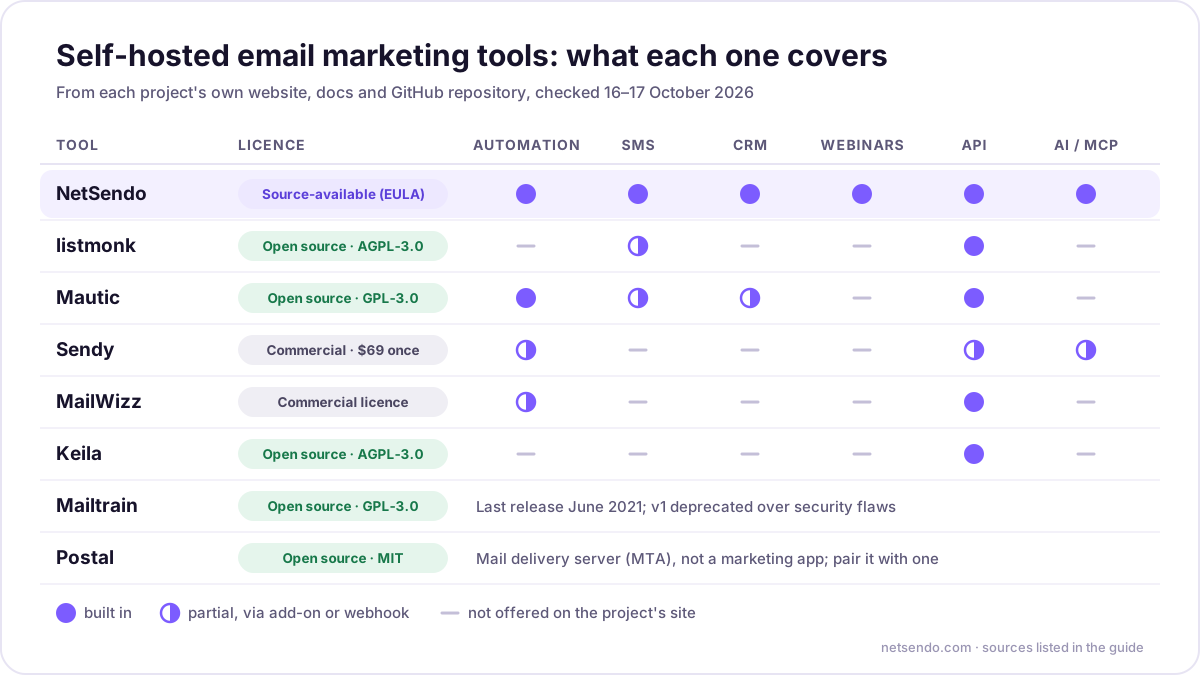 Feature coverage by tool, from each project's own pages, checked 16–17 October 2026.
| Tool | Licence | Price of the software | Stack | Automation | SMS | API | GitHub stars | Latest release |
|---|---|---|---|---|---|---|---|---|
| NetSendo | Proprietary, source-available (NetSendo EULA) | SILVER free licence; GOLD $97/month | Laravel, Vue.js, MySQL 8, Redis 7, Docker | Automations and funnels | Built in (5 gateways) | REST API, MCP server, signed webhooks | 17 | v2.1.3 (2026-09-14) |
| listmonk | Open source, AGPL-3.0 | Free | Go, Vue, PostgreSQL | No drip workflows advertised | Via webhook "messengers" | Yes | 23,816 | v6.2.0 (2026-06-26) |
| Mautic | Open source, GPL-3.0 | Free | PHP (Symfony) | Campaign builder, lead scoring | Via an SMS transport (Twilio plugin) | REST API | 10,784 | 7.2.1 (2026-09-23) |
| Sendy | Commercial | $69 one-time per domain | Self-hosted web app | Autoresponders (drip) | Not advertised | HTTP API (subscribers, campaigns) | No public repo | n/a |
| MailWizz | Commercial (Regular, Extended, Lifetime) | Not shown on the pricing page when checked | Self-hosted web app (PHP) | Follow-up campaigns | Not advertised | REST API (3.x) | No public repo | n/a |
| Keila | Open source, AGPL-3.0 | Free (also a hosted Keila Cloud) | Docker image | Listed as planned | Not advertised | Contacts, campaigns, forms | 2,237 | 0.30.3 (2026-09-06) |
| Mailtrain | Open source, GPL-3.0 | Free | Node.js, MySQL | Triggered and RSS campaigns | Not advertised | n/a | 5,758 | v2.20210609.0 (2021-06-09) |
| Postal | Open source, MIT | Free | Mail delivery server | n/a (not a marketing app) | n/a | Sending API | 16,867 | 3.3.7 (2026-06-03) |
Stars and releases from the GitHub API on 2026-10-16. Prices and features from vendor pages on 2026-10-16/17. "Not advertised" means the project's own site did not list it when checked.
NetSendo: the all-in-one option
NetSendo is a self-hosted email and SMS marketing automation platform built with Laravel, Vue.js and Docker. It runs on MySQL 8 and Redis 7, and the app listens on port 5029. Its scope is wider than the others here:
- MJML email editor, automations and funnels, segmentation and analytics.
- SMS through Twilio, Vonage, MessageBird, Plivo or SMSAPI. You pay the gateway directly.
- A CRM with a sales pipeline, plus live webinars. Auto-webinars and hybrid webinars come with GOLD.
- AI features with OpenAI, Anthropic Claude, Google Gemini, xAI Grok, OpenRouter or local models through Ollama.
- An MCP server (37+ tools) so assistants such as Claude or Cursor can work with your instance. See the self-hosted MCP server guide and /en/agents.
- A REST API, HMAC-signed webhooks and an n8n node, plus integrations with WordPress, WooCommerce, Stripe, Shopify, Calendly, Zoom and Google Meet.
- NMI, a built-in mail infrastructure with dedicated IPs, IP warming, DKIM and blacklist monitoring, if you want to run your own sending.
Licence and price. NetSendo is proprietary, source-available software under the NetSendo EULA. It is not open source: you can read the code on GitHub and run a licensed instance for your own business, but you may not redistribute, white-label or resell it as SaaS. The README says an active licence is required to operate. SILVER is a free licence with unlimited contacts. Per the pricing page, it includes email and SMS, the CRM, live webinars, automations, all integrations, the public API and MCP server, and up to 3 AI campaigns. GOLD is $97/month and adds unlimited AI campaigns, local LLM, A/B testing, auto-webinars and priority support. (The README's plan table lists API access under GOLD; where it matters for you, check the pricing page for the current split.) More on what source-available means in Is NetSendo open source?
Be aware: the public repository is young (17 stars on 2026-10-16), so the community and third-party tutorials are much smaller than for listmonk or Mautic.
listmonk: the best lean newsletter tool
listmonk is "free and open source software licensed under AGPLv3", with a Go backend and a Vue frontend on PostgreSQL (listmonk.app). It handles large lists, SQL-based segmentation, several editors, transactional messages through an API, and multi-SMTP queues with rate limiting.
Its "messengers" can push campaigns to SMS, WhatsApp or push services through an HTTP webhook you provide (docs). The site does not advertise drip sequences or visual automation workflows.
Choose listmonk if you want broadcasts and newsletters, minimal resources and a true open-source licence. For pure newsletters it is lighter than NetSendo or Mautic, and we would recommend it over both.
Mautic: the open-source marketing automation suite
Mautic calls itself "The World's Largest Open Source Marketing Automation Product" (mautic.org) and is GPL-3.0 on GitHub. It offers a click-and-drag campaign builder, point scoring for leads, and drag-and-drop email and landing pages. SMS works once you configure an SMS transport such as the Twilio plugin (docs). It also has a REST API.
Choose Mautic if you need B2B-style lead nurturing and scoring and the licence must be OSI open source. It is the most complete open-source automation option. Plan for more setup and tuning than a newsletter tool needs.
Sendy: the cheapest commercial broadcast tool
Sendy is a one-time "$69" purchase, valid for one domain, with free updates until the next major version (sendy.co). It sends through Amazon SES and also works with SendGrid, Mailjet and Elastic Email. It has autoresponders for drip campaigns, segments, white-labelled client accounts and an HTTP API. An optional AI Assistant is sold separately.
Choose Sendy if you want a simple, low-cost newsletter sender on SES and do not need SMS, CRM or advanced automation. Sendy quotes "$1.6 per 10,000 emails" via SES. SES's current list price is $0.10 per 1,000, or $1 per 10,000, before attachments or a dedicated IP.
MailWizz: for agencies that resell sending
MailWizz describes itself as "self-hosted email marketing software" that sends through "an SMTP server, Sendgrid, Amazon SES, Mailgun and much more" and lets you "create unlimited customers, groups, price plans" (mailwizz.com). It has a documented REST API.
Licences are Regular (your own lists) or Extended (when you charge customers), as yearly subscriptions or lifetime. The pricing page did not show prices when we checked, so confirm them with the vendor.
Choose MailWizz if you run an agency or ESP-style business and need multi-customer accounts.
Keila: a simple, EU-made open-source newsletter
Keila is "a 100% Open Source newsletter tool, made in Germany", AGPLv3, with an official Docker image and a hosted Keila Cloud (keila.io). It has a block editor, Markdown and MJML, a form builder with double opt-in and captcha, and an API for contacts, campaigns and forms. Marketing automations are listed as planned.
Choose Keila if you want a clean, modern newsletter tool and may later move to the hosted version.
Mailtrain and Postal: two special cases
Mailtrain (GPL-3.0) has triggered and RSS campaigns, but its latest release is v2.20210609.0 from June 2021. The v1 README states it "has been deprecated" and "contains security flaws which won't likely be fixed" (GitHub). We would not start a new project on it.
Postal (MIT) is a mail delivery server, not a marketing app. It has no list management or campaign editor. Use it as the sending layer under one of the tools above if you want to run your own MTA.
Open source, source-available or commercial: why does the licence matter?
The licence decides what you may do with the code, not how good the product is.
- Open source (OSI): listmonk and Keila (AGPL-3.0), Mautic and Mailtrain (GPL-3.0), Postal (MIT). You can use, modify and redistribute under the licence terms. AGPL adds a network clause: if you modify the software and let others use it over a network, you must offer them your source.
- Source-available: NetSendo. The code is public so you can read and audit it and report issues, but the EULA forbids redistribution, white-labelling and offering it as SaaS.
- Commercial, closed: Sendy and MailWizz. You buy a licence and get the software, with terms set by the vendor.
If your organisation has a policy that requires an OSI licence, your shortlist is listmonk, Keila and Mautic. If the policy is about data location and control, any self-hosted tool qualifies.
What does self-hosting really require?
Our rough estimate: an afternoon to install and a few hours a month to run, depending on experience. The software install is usually the easy part. NetSendo, for example, is four commands (git clone, cd NetSendo, cp .env.example .env, docker compose up -d) and needs Docker with Compose v2, at least 2 GB RAM and 5 GB disk (4 GB and 10 GB recommended). The quickstart has the details.
The work that takes time:
- A server with backups. A 4 GiB DigitalOcean droplet is $24/month, and weekly backups add 20% of the droplet cost (pricing).
- Domain authentication. Gmail requires senders of more than 5,000 messages a day to Gmail accounts to set up SPF, DKIM and DMARC (the policy "can be set to none"), support one-click unsubscribe and keep the spam rate "below 0.30%" (Google). Outlook.com rejects non-compliant mail from domains sending over 5,000 emails a day (Microsoft).
- Leaving the SES sandbox. New Amazon SES accounts can only send to verified addresses, with a maximum of 200 messages per 24 hours, until AWS approves production access. AWS gives an initial response within 96 hours (AWS docs).
- Bounce and complaint handling. Wire bounce and complaint notifications back into the app so bad addresses are suppressed automatically.
- Updates and monitoring. Apply releases, watch queues and disk, and check blocklists if you run your own IPs.
Our deliverability guide for self-hosted senders covers steps 2–4 in depth.
How should you send: Amazon SES, an SMTP relay or your own IPs?
For most teams, start with a relay. Amazon SES costs "$0.10 / 1,000 emails", and a dedicated IP is "$24.95 / month / IP" if you outgrow shared IPs (AWS). Mailgun, SendGrid and similar providers work the same way through SMTP or API.
Running your own MTA (Postal, or NetSendo's NMI with dedicated IPs and warming) removes per-email fees. In exchange you own the IP reputation: warm-up schedules, blocklist monitoring and abuse handling. Do that only when volume justifies it and someone owns deliverability. No tool can guarantee inbox placement. That depends on your list, your content and your authentication.
NetSendo itself has no sending limits; volume depends on the provider you connect (SES, Mailgun, SendGrid, Gmail API or NMI).
What does self-hosted email marketing cost?
The licence is often the smallest line. A worked example from our cost guide: 100,000 contacts at 4 sends a month means 400,000 emails. That comes to SES $40, plus an 8 GiB droplet at $48, weekly backups at $9.60 and a dedicated IP at $24.95, for about $123/month on a free licence. The same list is $800/month on Mailchimp Standard and $439/month on MailerLite (monthly billing, checked 2026-10-16). That figure is an estimate, it does not include your time, and the cost guide shows when SaaS comes out cheaper.
| Licence cost | Tools |
|---|---|
| Free | listmonk, Mautic, Keila, Mailtrain, Postal, NetSendo SILVER (free licence; server and sending paid separately) |
| One-time | Sendy, $69 per domain |
| Subscription or lifetime | MailWizz (price not shown on the vendor page when checked), NetSendo GOLD $97/month |
How do you choose? Four questions
Answer these in order and stop at the first match.
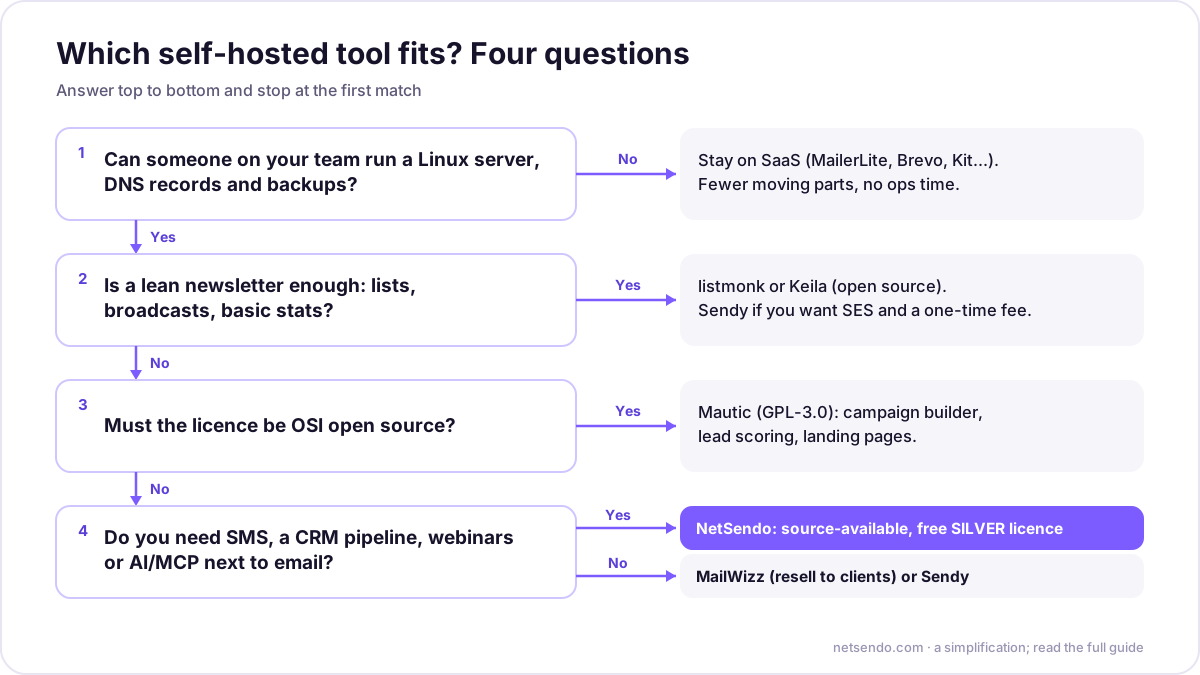 A simplified decision flow. Real projects often have more constraints, such as existing integrations or team skills.
- Can someone run a Linux server, DNS and backups? If not, use SaaS.
- Is a lean newsletter enough? Then use listmonk or Keila, or Sendy if you prefer a one-time commercial licence on SES.
- Must the licence be OSI open source? Then use Mautic for automation, or listmonk/Keila for newsletters.
- Do you need SMS, a CRM pipeline, webinars or AI/MCP next to email? Then NetSendo fits. If you mainly resell sending to clients, look at MailWizz.
When is NetSendo not the right choice?
We would point you elsewhere if:
- You only send a weekly newsletter. listmonk does that with less to run.
- You need an OSI open-source licence. NetSendo is source-available. Use Mautic, listmonk or Keila.
- You want to resell the platform or white-label it. The NetSendo EULA does not allow that. MailWizz's Extended licence is built for it.
- You want zero operations. NetSendo's managed cloud hosting is planned (+$39/month) but not live yet. Until then, a SaaS tool is simpler. Our self-hosted Mailchimp alternative guide compares the trade-offs in detail.
Next steps
- Compare the numbers for your list size in the cost guide.
- Read the deliverability guide before you send your first campaign.
- If NetSendo fits, the quickstart gets a test instance running with Docker. Pricing has the SILVER and GOLD details.
Frequently asked questions
What is the best self-hosted email marketing software?
Is there an open-source self-hosted alternative to Mailchimp?
Do I still need Amazon SES or an SMTP provider if I self-host?
How much does self-hosted email marketing cost?
Is self-hosting worth it for a small list?
Is NetSendo open source?
Which self-hosted tool supports SMS?
Try NetSendo on your own server
Self-hosted email & SMS marketing with a free Silver license. Install with Docker Compose in minutes.
Sources
- listmonk (GitHub repository) · checked 2026-10-16
- listmonk website · checked 2026-10-17
- listmonk docs: Messengers · checked 2026-10-17
- Mautic (GitHub repository) · checked 2026-10-16
- Mautic website · checked 2026-10-17
- Mautic docs: Text messages (SMS) · checked 2026-10-17
- Mautic developer documentation · checked 2026-10-17
- Sendy · checked 2026-10-17
- Sendy API · checked 2026-10-17
- MailWizz · checked 2026-10-17
- MailWizz pricing · checked 2026-10-17
- MailWizz 3.x REST API documentation · checked 2026-10-17
- Keila · checked 2026-10-17
- Keila API documentation · checked 2026-10-17
- Keila (GitHub repository) · checked 2026-10-16
- Mailtrain (GitHub repository) · checked 2026-10-17
- Postal (GitHub repository) · checked 2026-10-16
- NetSendo (GitHub repository and README) · checked 2026-10-17
- Amazon SES pricing · checked 2026-10-17
- Amazon SES: request production access (sandbox) · checked 2026-10-17
- DigitalOcean Droplet pricing · checked 2026-10-17
- Google: Email sender guidelines · checked 2026-10-17
- Microsoft: Outlook requirements for high-volume senders · checked 2026-10-16
- Mailchimp pricing · checked 2026-10-16
- MailerLite pricing · checked 2026-10-16