

Listmonk vs Mautic vs NetSendo: which self-hosted tool fits?
Updated: · 14 min read · NetSendo Team
Listmonk, Mautic or NetSendo: which one should you pick?
Pick by the job, not by the feature count. After checking each project's own site, docs and GitHub repository on 17 October 2026, our short answer is:
- listmonk if you send newsletters and broadcasts, often to large lists, and want the lightest open-source option. It is AGPL-3.0, written in Go, and runs as a single binary on PostgreSQL.
- Mautic if you need open-source marketing automation: a visual campaign builder, segments, lead points and stages, landing pages and forms. It is GPL-3.0 and PHP-based, which suits teams that already run PHP or Drupal sites.
- NetSendo if you want email, SMS, a CRM with a sales pipeline, webinars and an MCP server for AI assistants in one self-hosted app. It is source-available, not open source, with a free SILVER licence for your own business. You still pay for the server and for sending.
The three tools are not really competitors at the same level. listmonk is a newsletter engine, Mautic is an automation suite, and NetSendo is an all-in-one marketing platform. The rest of this guide shows where those differences matter.
How do listmonk, Mautic and NetSendo compare at a glance?
The table below covers licence, stack and project activity. All three are self-hosted, and all three need a separate sending provider (Amazon SES, Mailgun, an SMTP relay or your own mail servers).
| listmonk | Mautic | NetSendo | |
|---|---|---|---|
| What it is | Newsletter and mailing list manager | Marketing automation suite | Email + SMS marketing automation with CRM and webinars |
| Licence | Open source, AGPL-3.0 | Open source, GPL-3.0 | Proprietary, source-available (NetSendo EULA) |
| Price of the software | Free | Free | SILVER free licence; GOLD $97/month |
| Stack | Go (single binary), Vue frontend | PHP (Symfony) | PHP (Laravel), Vue.js frontend |
| Database | PostgreSQL 12 or newer | MySQL 5.7+ or MariaDB 10.2+ | MySQL 8 and Redis 7 |
| Install | Binary or Docker Compose | PHP application on your web server, plus cron jobs | Docker Compose (4 commands) |
| Latest release | v6.2.0 (2026-06-26) | 7.2.1 (2026-09-23) | v2.1.3 (2026-09-14) |
| GitHub stars | 23,815 | 10,786 | 17 |
Stars and releases from the GitHub API on 17 October 2026. Requirements from listmonk's installation docs, Mautic's requirements page and the NetSendo README.
What licence does each tool use, and why does it matter?
listmonk and Mautic are OSI open source. NetSendo is not. That difference decides what you may do with the code, not how good each product is.
- listmonk: AGPL-3.0. The site says "listmonk is free and open source software licensed under AGPLv3" (listmonk.app). You can use, modify and redistribute it. The AGPL network clause means that if you modify listmonk and let other people use your modified version over a network, you must offer them the source.
- Mautic: GPL-3.0. The repository ships a GPL-3.0 licence. You can modify and redistribute it under GPL terms. The project is governed as "the Mautic project of the Open Source Collective", per the Mautic website.
- NetSendo: source-available EULA. The code is public on GitHub so you can read and audit it, report issues and propose changes. You may run a licensed instance for your own business. You may not redistribute it, white-label it or offer it as SaaS, and the README states that no plan includes white-label or rebranding rights. Details are in Is NetSendo open source?
If your organisation requires an OSI licence, the choice is between listmonk and Mautic. If the requirement is about keeping subscriber data on infrastructure you control, all three qualify. That helps with GDPR obligations, but compliance still depends on how you run the system.
What do you need to run each one?
All three run on one Linux server for small and mid-size lists. They differ in how many moving parts you look after.
listmonk: one binary and PostgreSQL
listmonk "requires a Postgres database instance to run", version 12 or newer (installation docs). You download the binary, generate a config with --new-config, create the tables with --install and start it, or you use the official Docker Compose file. Pre-built binaries exist for Linux, macOS, Windows and the BSDs.
Bounce handling is built in. listmonk can scan a POP3 bounce mailbox, or receive bounce events from Amazon SES, SendGrid, Postmark, Azure ACS and others through webhooks (bounce docs).
Mautic: a PHP application with cron jobs
Mautic 7.0 supports PHP 8.2, 8.3, 8.4 and 8.5, needs MySQL 5.7+ or MariaDB 10.2+ with InnoDB, and requires npm from Mautic 5.0 onwards, plus PHP extensions such as intl, imap, gd, zip and bcmath (requirements).
The part that surprises newcomers is cron. The docs say "You must manually add the required cron jobs to your server": mautic:segments:update, mautic:campaigns:update, mautic:campaigns:trigger, mautic:messages:send and a custom-field job (cron docs). If cron stops, segments go stale and campaigns stop moving.
NetSendo: Docker Compose with MySQL and Redis
NetSendo is a Laravel and Vue.js app that runs in Docker with MySQL 8 and Redis 7, listening on port 5029. Installation is four commands (git clone, cd NetSendo, cp .env.example .env, docker compose up -d). It needs Docker 20.10+ with Compose v2, at least 2 GB RAM and 5 GB disk, with 4 GB and 10 GB recommended. The Compose file starts separate scheduler and queue-worker containers (php artisan schedule:work and queue:work), so you do not wire up cron by hand (docker-compose.yml). The quickstart has the details. You also activate a SILVER or GOLD licence in the app; the README says an active licence is required to operate.
How do the features compare side by side?
listmonk is strongest at campaigns and segmentation, Mautic at automation and lead management, and NetSendo at breadth of channels. The matrix shows each tool's own documentation, not our guesses.
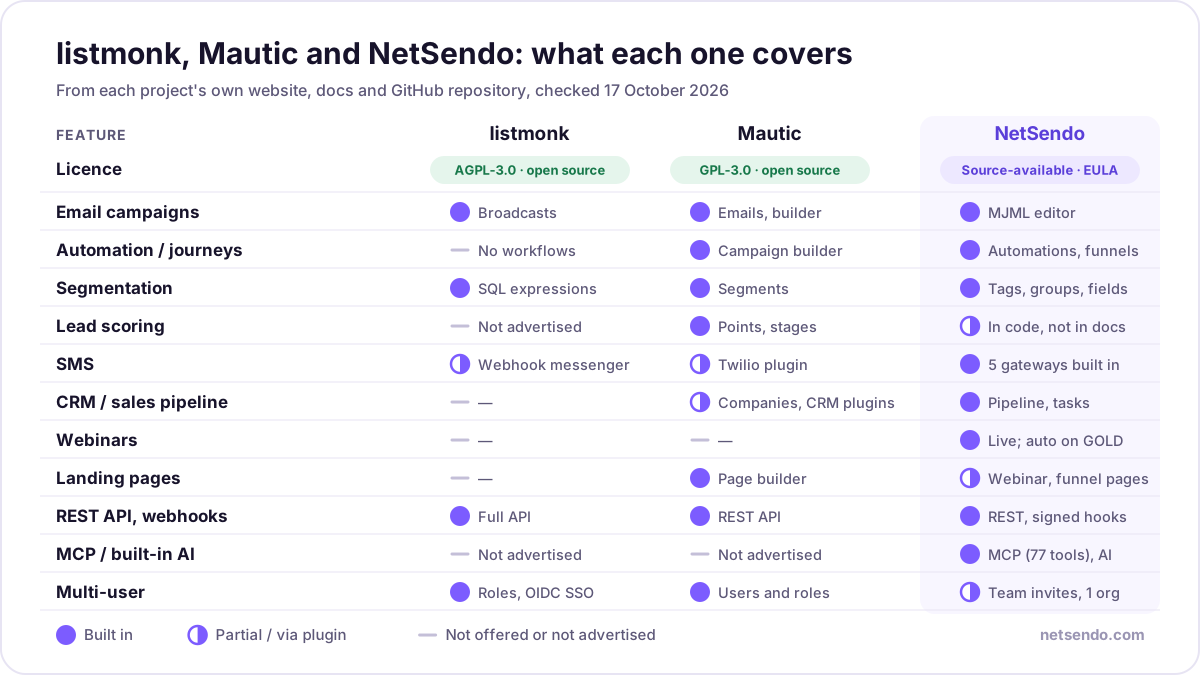 Feature coverage from each project's own site, docs and repository, checked 17 October 2026.
| Feature | listmonk | Mautic | NetSendo |
|---|---|---|---|
| Email campaigns | Yes: drag-and-drop, WYSIWYG, Markdown, HTML editors | Yes: drag-and-drop email builder | Yes: MJML editor, drag-and-drop templates |
| Automation / journeys | No drip workflows advertised | Visual campaign builder | Automations (when / if / then rules) and funnels |
| Segmentation | SQL expressions over subscriber data | Segments with filters | Lists, tags, groups and custom fields |
| Lead scoring | Not advertised | Points and point groups, stages | In the public code, not in the docs yet |
| SMS | Via a webhook "messenger" to your gateway | Via an SMS transport (Twilio plugin) | Built in: Twilio, Vonage, MessageBird, Plivo, SMSAPI |
| CRM / sales pipeline | No | Companies and stages; CRM sync plugins | CRM with sales pipeline and tasks |
| Webinars | No | No | Live webinars (SILVER); auto and hybrid (GOLD) |
| Landing pages | No | Yes, page builder | No general builder; webinar and funnel pages |
| API and webhooks | Extensive API, granular API tokens | REST API | REST API, HMAC-signed webhooks, n8n node |
| MCP / built-in AI | Not advertised | Not advertised | MCP server (77 tools); OpenAI, Claude, Gemini, Grok, OpenRouter, Ollama |
| Multi-user | Roles, permissions, OIDC SSO | Users and roles | Team invitations and roles in the code; one organisation per instance |
Sources: listmonk.app, Mautic docs, mautic.org, NetSendo pricing, README and public source code, checked 17 October 2026.
Campaigns and editors
All three send regular campaigns well. listmonk stands out for throughput: multi-threaded, multi-SMTP queues with rate limiting, and Go templating with more than 100 functions in subjects and bodies (listmonk.app). Mautic's drag-and-drop builder covers both emails and landing pages. NetSendo uses an MJML editor and a drag-and-drop template builder, with open, click and conversion statistics.
Automation and journeys
This is the biggest split. listmonk does not advertise drip sequences or visual workflows. You can trigger transactional messages through its API, but multi-step journeys need an external tool.
Mautic has a click-and-drag campaign builder in which contacts move through decisions, actions and conditions (mautic.org). It is built for B2B-style nurturing.
NetSendo has two layers. Automations are rules: when an event happens (signup, activation, email opened, link clicked, form submitted, tag added or removed, field updated, bounce, unsubscribe), if conditions match, then run actions such as send email, add or remove a tag, move or copy to a list, call a webhook, start a funnel or notify an admin (source strings). Funnels are a separate builder for multi-step sequences. Both are in the SILVER licence per the pricing page.
Segmentation and lead scoring
listmonk lets you write subscriber queries as SQL expressions, which is powerful if your team knows SQL. Mautic has segments, plus points, point groups and stages for scoring and lifecycle tracking (docs contents).
NetSendo segments by lists, tags, groups and custom fields. Its public code also contains a lead-scoring module with rules per event type and score history (migration). It is not described in the README or on the pricing page yet, so check it in the demo before you rely on it. For scoring today, Mautic is the documented choice.
SMS
NetSendo is the only one with SMS built in: five gateways, and you pay the gateway directly. Mautic sends SMS once you configure a transport such as its Twilio plugin. listmonk's "messengers" post messages to an HTTP webhook you provide, so you write or host the bridge to your SMS provider (listmonk.app).
CRM and sales pipeline
NetSendo's pricing page lists a "Complete CRM with Sales Pipeline" in SILVER. In the code, deals sit in pipelines with stages, values and owners, linked to contacts and companies (migration). CRM tasks sync with Google Calendar, Google Meet and Zoom (docs).
Mautic tracks companies and lifecycle stages. Its Stages docs talk about tracking contacts through marketing phases and do not describe deals or pipelines (Stages). For sales pipelines it syncs with external CRMs such as Salesforce, HubSpot, Pipedrive, Zoho CRM, SugarCRM, Vtiger and Microsoft Dynamics through plugins. listmonk has no CRM.
Webinars
Only NetSendo has webinars. Live webinars (YouTube) are in SILVER. Auto-webinars with a scenario builder and hybrid webinars come with GOLD. If webinars drive your funnel, that removes a separate webinar subscription and its integration.
API, MCP and AI
All three have APIs. listmonk advertises "extensive API coverage for all features" with granular API tokens. Mautic has a REST API and a plugin ecosystem. NetSendo has a REST API, HMAC-signed webhooks and an n8n node (n8n-nodes-netsendo).
For AI assistants, NetSendo ships an MCP server: 77 tools in @netsendo/mcp-client 1.5.1, so Claude, Cursor or VS Code can work with lists, campaigns and funnels on your instance. It also has AI features with OpenAI, Anthropic Claude, Google Gemini, xAI Grok, OpenRouter or local models through Ollama. SILVER includes up to 3 AI campaigns; GOLD has unlimited AI campaigns and local LLM. listmonk and Mautic do not advertise an MCP server on their own sites. See the self-hosted MCP server guide and /en/agents.
Multi-user
listmonk has granular roles and permissions with OIDC single sign-on. Mautic has users and roles. NetSendo's home-page FAQ describes it as single-tenant, built for one organisation, with separate Docker instances for different clients. Inside that organisation, the code has team invitations and Admin and User roles (seeder). Agencies should read the EULA terms in Is NetSendo open source? before running instances for clients.
How much setup and maintenance does each one need?
listmonk needs the least ongoing work, Mautic the most. This is our assessment from the requirements above, not a benchmark.
| Task | listmonk | Mautic | NetSendo |
|---|---|---|---|
| First install | Binary or Docker, plus PostgreSQL | PHP stack, database, npm, extensions | Docker Compose, then licence activation |
| Scheduled jobs | No cron jobs in the install steps | Five mandatory cron jobs | Scheduler and queue containers |
| Updates | New binary or Docker image | Update package or Composer; test plugins and themes | docker compose pull and restart |
| Moving parts to watch | App, PostgreSQL | Web server, PHP, database, cron, plugins | App containers, MySQL, Redis, queues |
| Tuning for large lists | Rate limits and SMTP pools | Cron frequency, batch sizes, queue | Queue workers, sending provider limits |
Common to all three: DNS authentication (SPF, DKIM, DMARC), a sending provider, bounce and complaint handling, and backups. Our deliverability guide for self-hosted senders covers that layer.
What does each one cost to run?
The licences of listmonk and Mautic are free, and NetSendo SILVER is a free licence for your own business. So the real cost is infrastructure and time, and it looks similar for all three.
A worked example: 50,000 contacts at 4 emails a month means 200,000 emails. On Amazon SES at $0.10 per 1,000 emails that is $20, plus an 8 GiB DigitalOcean droplet at $48 and weekly backups at 20% ($9.60), for about $78/month before a dedicated IP ($24.95/month on SES). Prices are from AWS and DigitalOcean, checked 17 October 2026, and the server size is our assumption. NetSendo GOLD adds $97/month if you need its extra features.
listmonk can often run on a smaller server than this, which makes it the cheapest of the three for pure newsletters. For SaaS comparisons at 10k, 50k and 100k contacts, see what it costs to email 10k, 50k and 100k contacts.
How active are the three projects on GitHub?
All three are actively maintained. listmonk and Mautic have much larger communities; NetSendo is a young public repository with frequent small releases.
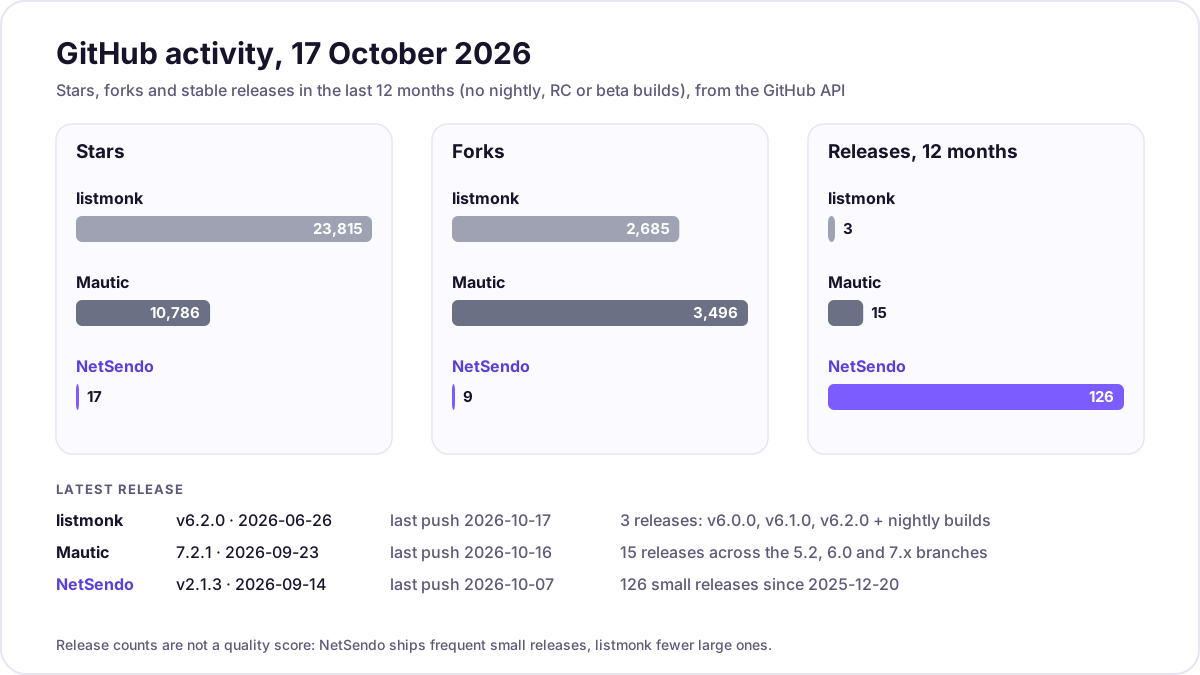 GitHub API data on 17 October 2026. Stable releases exclude nightly, RC and beta builds.
| listmonk | Mautic | NetSendo | |
|---|---|---|---|
| Stars | 23,815 | 10,786 | 17 |
| Forks | 2,685 | 3,496 | 9 |
| Latest release | v6.2.0, 2026-06-26 | 7.2.1, 2026-09-23 | v2.1.3, 2026-09-14 |
| Stable releases since 2025-10-17 | 3 (v6.0.0 on 2026-01-02, v6.1.0, v6.2.0), plus nightly builds | 15, across the 5.2, 6.0 and 7.x branches (7.0.0 on 2026-01-20) | 126, since the first public release v1.0.1 on 2025-12-20 |
| Last push to the repository | 2026-10-17 | 2026-10-16 | 2026-10-07 |
Source: GitHub repositories and releases for listmonk, Mautic and NetSendo.
Release counts are not a quality score. listmonk ships a few large releases a year, Mautic maintains several branches in parallel, and NetSendo publishes many small versions. Stars matter more for one thing: how many tutorials, answered questions and third-party integrations you will find. On that measure, listmonk and Mautic are far ahead.
Who should pick which?
Each tool is the right answer for someone. Here is how we would decide.
Choose listmonk if:
- You mainly send newsletters, announcements or digests, possibly to very large lists.
- You want minimal infrastructure: one binary and PostgreSQL.
- Your team is comfortable with SQL for segmentation.
- The licence must be OSI open source.
- You do not need drip sequences, or you are happy to drive them from an external workflow tool through the API.
For a lean, high-volume newsletter, listmonk is a better choice than both Mautic and NetSendo.
Choose Mautic if:
- You need open-source marketing automation with a visual campaign builder, lead points and lifecycle stages.
- You run B2B lead nurturing and sync leads into Salesforce, HubSpot, Pipedrive or another CRM.
- Your team already runs PHP or Drupal sites and is comfortable with cron, Composer and PHP extensions.
- You want landing pages and forms in the same tool.
Choose NetSendo if:
- You want email, SMS, a CRM pipeline and webinars in one app instead of four tools and their integrations.
- You sell through webinars or funnels with Stripe, Polar, Shopify or WooCommerce.
- You want an AI assistant to work against your own instance through MCP, possibly with local models (Ollama).
- A source-available licence is acceptable, and you accept a smaller community than listmonk or Mautic.
When NetSendo is the wrong pick: you only send a weekly newsletter (listmonk does that with less to run), you need documented lead scoring today (Mautic), your policy requires an OSI licence (listmonk or Mautic), or you want to resell or white-label the platform (the EULA does not allow it).
Can you switch between them later?
Yes, the subscriber data moves easily; the logic does not. Contacts travel as CSV files or through the APIs, so lists, custom fields and tags can be carried over with some mapping. Automations, segments and templates have to be rebuilt by hand, because each tool models them differently.
When you move contacts, import unsubscribed and bounced addresses into the new tool's suppression list so they are never mailed again, and keep proof of consent. If you migrate into NetSendo, switch off trigger_automations during the import so old subscribers do not receive a welcome sequence. The self-hosted Mailchimp alternative guide has a full migration checklist that applies here too.
Next steps
- Compare all the self-hosted options, including Sendy, MailWizz and Keila, in the best self-hosted email marketing software.
- If you are leaving a SaaS automation tool, read the ActiveCampaign alternative guide.
- To try NetSendo, the quickstart gets a test instance running with Docker. Pricing has the SILVER and GOLD details.
Frequently asked questions
Is listmonk better than Mautic?
Does listmonk have marketing automation?
Is Mautic hard to self-host?
Is NetSendo open source like listmonk and Mautic?
Which of the three supports SMS?
Which tool has a CRM with a sales pipeline?
Can I connect Claude or another AI assistant to these tools?
Try NetSendo on your own server
Self-hosted email & SMS marketing with a free Silver license. Install with Docker Compose in minutes.
Sources
- listmonk (GitHub repository) · checked 2026-10-17
- listmonk releases · checked 2026-10-17
- listmonk website · checked 2026-10-17
- listmonk docs: Installation · checked 2026-10-17
- listmonk docs: Bounce processing · checked 2026-10-17
- Mautic (GitHub repository) · checked 2026-10-17
- Mautic 7.2.1 release · checked 2026-10-17
- Mautic website · checked 2026-10-17
- Mautic requirements · checked 2026-10-17
- Mautic documentation (contents: segments, points, stages, SMS, users and roles, plugins) · checked 2026-10-17
- Mautic docs: Cron jobs · checked 2026-10-17
- Mautic docs: Stages · checked 2026-10-17
- NetSendo (GitHub repository and README) · checked 2026-10-17
- NetSendo docker-compose.yml (services: app, scheduler, queue, MySQL 8, Redis 7) · checked 2026-10-17
- NetSendo releases · checked 2026-10-17
- NetSendo source: automation triggers and actions (English UI strings) · checked 2026-10-17
- NetSendo source: CRM deals table migration · checked 2026-10-17
- NetSendo source: lead scoring rules migration · checked 2026-10-17
- NetSendo source: roles and permissions seeder · checked 2026-10-17
- NetSendo docs: Google Calendar integration (CRM tasks) · checked 2026-10-17
- Amazon SES pricing · checked 2026-10-17
- DigitalOcean Droplet pricing · checked 2026-10-17